
Training a dog to Settle: How Treats Have Betrayed You
Updated: Jan 1
Dr. Sarah Shapiro-Ward | 22-Dec-2025 (original version published 10-Nov-2023)

Introducing Settle Settle is the most misunderstood dog training exercise regularly taught at The Dog School. The idea is that when asked to settle, dogs will relax and remain quiet and calm for long periods of time, for example when at the office, or when getting brunch at a dog friendly patio. Many dog training schools don’t teach a “settle” at all, and the ones that do often teach a “stay” in place of a “settle”. While there’s nothing wrong with teaching “stay”, when a “stay” masquerades as a “settle”, it will typically backfire. In this article, I plan to lay out exactly what a “settle” is (and what it isn’t!), when to use a “settle” vs. when to use a “stay”, and the best practices for teaching it. It may be a surprise to hear, given that we use many treats at The Dog School, but it is our strong belief that “settle” should not be taught using treats.
Like most of the really good side of dog training, a nuanced understanding of training theory gives us a strong advantage over blindly following protocols. There are a few settle protocols out there (with and without treats!), but a true understanding of how and why they work is crucial for achieving the desired results. As a result, this article is quite long and goes into a significant amount of detail. For a more concise summary, you can skip to the last section (but, be warned! You may miss some important nuance and that would make me sad).
Settle Vs. Stay (or, how treats have betrayed you)
A “Stay” in dog training is when the dog holds a set position for an amount of time as determined by the handler. The dog is cued first into position, often a sit or down. The position cue can also direct the dog to a dog bed, mat or other target place. When the dog is in position, a stay cue is given. The dog is then still until a release cue is given by the handler. During a “Stay” exercise, we can observe that the dog is ready at all times to be released through the way they watch their handler. The dog is not typically relaxed, but actively participating in the exercise.
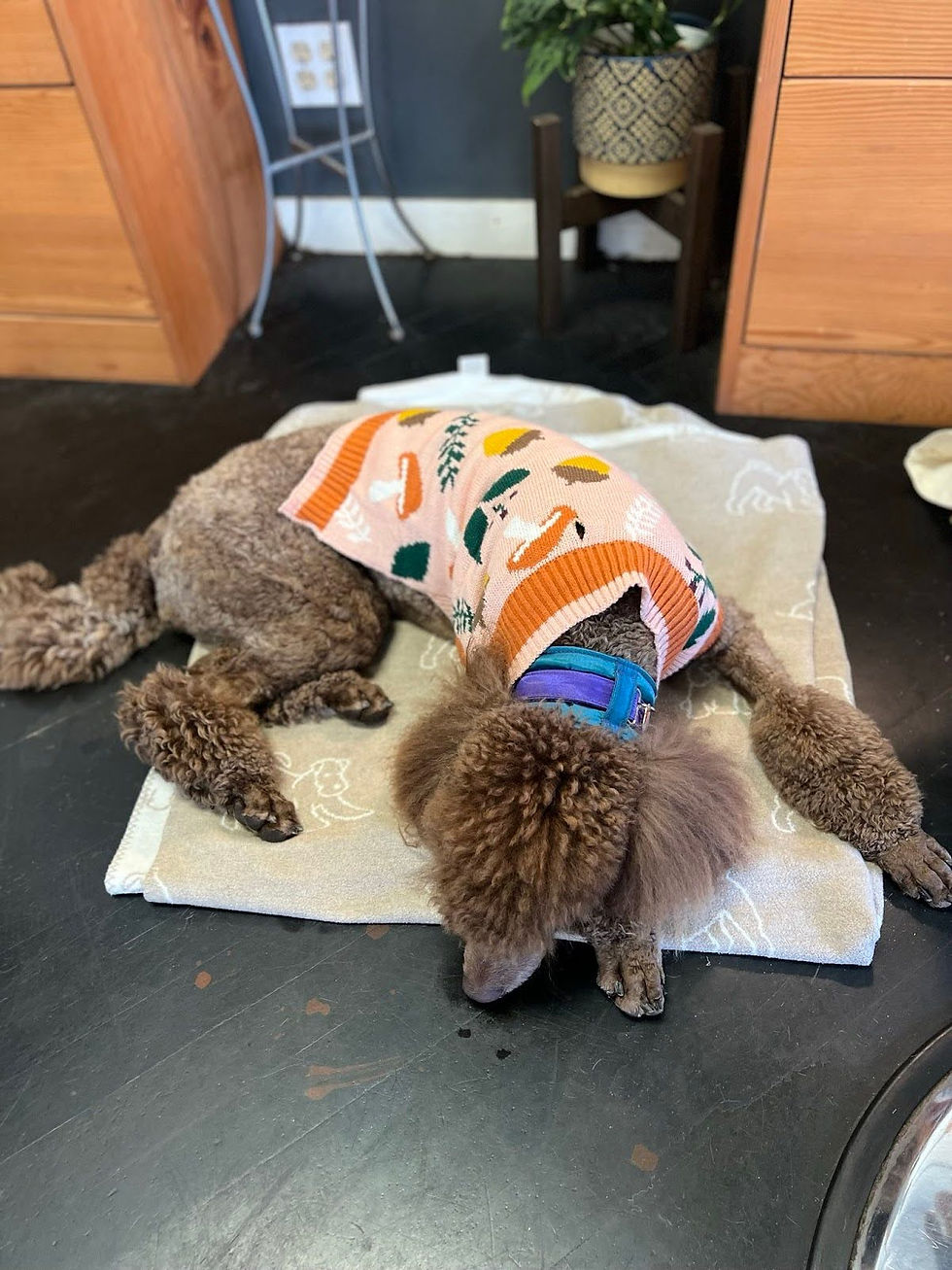
On the other hand, a settled dog is often relaxed or even asleep. They may be curled up on a bed or by the handler’s feet. A settled dog is allowed to get up for some water and return to relaxing as needed, and they aren’t concentrating on their handler. In fact, most of the time the handler is busy with another activity, so the human half of the equation isn’t paying attention either. Ultimately, a settle is the absence of working, whereas a stay is a working cue. They are fundamentally different behaviours, with important and distinct use-cases.
Key Differences:
Stay | Settle |
Cues from Handler (Verbal, Hand Signal) | Cues from context (Environmental) |
Engaged with Handler | Disengaged with Handler |
Alert Body Language | Relaxed Body Language |
Expectation of Reinforcement | No Expectation of Reinforcement |
When Stay-As-Settle Backfires
The problem with teaching “Stay” in lieu of a settle is that Stays are active exercises which are reinforced. This means that there is a contract between you and the dog—you’re working together on the exercise. The dog believes holding position will result in reinforcement, and the human has an obligation to provide that reinforcement. The Stay-As-A-Settle can therefore backfire in the following ways:
Treat-Machine. A functional 1-3 minute stay might be useful for elevators, meal prep, crosswalks or collecting your uber delivery from the front door, but this stay won’t hold up to an hour at the brewery. Dispensing food every 1-3 minutes for stay-after-stay leads to a frazzled human who can’t focus on other things and an active dog who can’t relax because they are working!
Extinction-Burst. If you train a stay and break your side of the contract by no longer providing reinforcement (or paying attention), your dog will feel cheated. Failing to reinforce a behaviour that has been previously reinforced is a type of Negative Punishment (P-) known as extinction. The idea is that over time, the previously reinforced Stay will no longer happen because it’s no longer valuable to the dog. This isn’t a great idea because it will punish your dog’s ability to stay, weakening the “Stay” behaviour. It’s also not a quiet process; your dog will experience a burst of frustration before giving up, usually characterised by barking, whining, pacing or even mouthing and humping. It’s easy to see why people become Treat-Machines, when one of the alternatives involves not only breaking your dog’s “Stay” but is also loud and annoying.
Super-Stay. Finally, the last way this backfires is that sometimes handlers will simply train insane stays with durations up to an hour or more. If you make your stay long enough, it solves the problem, right? Well, not really. Training a 1-hour plus stay is quite challenging as a training project, for one, and for another it results in a dog who still can’t “switch off”. On the one hand, if you successfully train a long-duration stay, you’ll have a dog who can’t make use of the down time to nap, and on the other hand if your dog starts to settle and relax during a stay, you weaken your dog’s active participation in the stay game, weakening the stay overall. And regardless of which way your Super-Stay progresses, this is a truly crazy over-engineered solution.
Sometimes this stay-as-settle does backfire in the right way and your dog begins to settle or stay based on external cues. Dogs are pretty smart, they can figure out that you want a stay when you’re in the obedience ring, but you really want a settle when you’re drinking coffee with your nose in a book. Dogs are smart enough to read the room and learn context cues, but relying on them to figure this out on their own is, in my opinion, a deeply stupid training strategy. Karen Overall’s famous Relaxation protocol (which is a super-stay, by the way) has pages of steps and works by degenerating the highly reinforced stay gradually into a settle over time by making it deeply boring and long-duration. Instead of using treats to methodically phase them out… you could just teach a settle. Trust me, it takes way less time and is far less confusing for your dog.
Alternative Settle Strategies
Some clicker trainers have noticed that treating stay as a settle doesn’t work, and so have switched gears and come up with new protocols and strategies. I’ve seen the following solutions presented, and I’ve experimented on most of them with varying levels of success:
Clicking for Relaxed Behaviours. This is where trainers will click and reinforce relaxed behaviours the dog does, for example lying on their bed, flopping onto their side, stretching, taking a deep breath and so on. In theory, we get more of what we reinforce, and so we should get more relaxed behaviours… right? In practice, no. What happens is that your dog either doesn’t make the connection between the behaviour and the click/treat (because they aren’t intentionally offering the behaviour) or your dog starts to offer the behaviour intentionally as a party trick without the associated relaxed mental state. If this works, it ends up working for the same reason as the Super-Stay does, and not because it’s a clever or elegant training method. The problem here is that food elicits a conditioned emotional response (CER) which is not compatible with sleeping. There is an argument to be made for teaching your dog to intentionally take a deep breath to help steady them in stressful situations, however because breathing is involuntary, capturing this behaviour such that it is intentionally offered on cue is actually very advanced and difficult to do (and it still won’t teach a settle).
Single-Rep Sessions. I actually like single rep sessions. This is where you mark and reinforce your dog ONCE for a behaviour, and then end the training session. The good behaviour is reinforced (once), but the dog starts to learn not to expect more treats right away. This can help reduce excitement around receiving food, and prevent dogs spiraling into an engaged work-mode right after eating a single piece of kibble. Is it a good training exercise? Yes. Does it train a reliable settle? No, not really. If it’s working, it’s most likely due to habit forming.
Using a Different Marker (“good”) and Praise instead of Clicks and Treats. The clicker or “yep!” marker can be extremely exciting for dogs because its associated with food. I have had some success using a different verbal marker “good” and pairing this with calm petting and verbal praise. I can then mark and reinforce calm behaviours with a reinforcement strategy that fits the mood, preventing escalation into “work-mode”. This works well in some cases, but the fall out of reinforcement still exists. We can end up with a dog who demands constant petting while settling, or we can have a dog who actually wants to be left alone while they sleep and finds petting annoying. Ultimately, it’s not a terrible idea, but it has to be used carefully and with consideration to whether the individual dog benefits from this strategy (which can change moment to moment even for the same dog, and may be incompatible with some dogs entirely).
Non-Contingent Reinforcement. This strategy involves delivering a treat randomly, not contingent for any particular behaviour. Non-contingent reinforcement works very well for dogs who are easily distracted or worried by the environment, because it keeps dogs relatively calm in one place, and can lower the frustation involved in being on-leash. In order for this strategy to work and not to backfire, the treats must be truly non-contingent on the dog's behaviour, meaning that they occur without the dog doing anything in particular to trigger them. The treats must also be low enough value and delivered sporadically so as not to trigger "work mode". I still use this method for dogs with hyper-arousal or timidity, but I find using a pacifier (explained later) works more optimally in the majority of cases.
Interval Schedule Reinforcement. The most common reinforcement schedules are continuous ratio (dog gets a treat every time they complete a behaviour) and variable ratio (dog gets a treat sometimes when they complete a behaviour, but not every time). These two schedules tend to make up most of dog training, so sometimes people are surprised when I explain that there’s actually half a dozen other schedules out there. Interval schedules of reinforcement (a treat presented in pre-set time-intervals) are good for encouraging settling because the dog learns to “wait” during the “dead time” in the interval where food is not available. This works by removing the expectation of a treat in between repetitions of behaviour, which… sounds familiar, right? Removing expectation of food strikes again. Interval schedules of reinforcement can be contingent on a specific behaviour (a treat will drop every few minutes IF you are on your bed) or it can be non-contingent (a treat will drop every few minutes on your bed, regardless of what you do). A ratio interval schedule will drop food predictably (say, every 5 minutes on the dot) whereas a variable interval schedule will drop treats at random intervals with no predictable pattern (any time between 1 and 10 minutes, for example). Non-contingent variable interval reinforcement can be so powerful that animals will wait calmly all day by their treat drop-site at the expense of expressing other natural behaviours. I heard a story once of a cat owner who bought an automatic feeder to dispense food at intervals while she was away, and found her cat would hang out by the magic machine all day at the expense of their normal behaviours (napping in the sun, playing, exploring etc). Powerful reinforcement strategies can mask natural behaviours, so be cautious of this when using them in training. Besides being over-engineered and difficult to understand, these solutions are often difficult to implement and adjusted frequently with progression.
Calm Human, Calm Dog. Finally, the last method I’ve seen focuses on getting the human half of the equation to settle down, so that the dog can settle down. There’s a lot of truth in this one—our own body language and behaviour affects our dogs tremendously. It’s a good idea to chill out if you want your dog to chill out, and especially to avoid escalating your behaviour alongside your dog’s behaviour. Settling is all about context-cues, and your behaviour is a big part of the picture. That said, this isn’t the complete picture for how to train a settle. Frequently I ask one of my dogs to settle while the other is working, putting me in a “working” state. If it was a simple as I relax, so you relax, we’d never be able to work one dog while setting another. I also find it quite egotistical to assume that every aspect of dog training comes down to the human’s mental state. Dogs are pretty smart and can learn to be chill all by themselves under the right circumstances, so we should give them some credit for that. Besides, if you're trying to calmly watch TV while your dog is busy being a hooligan, you'll already know that there's simply more to it. Ultimately, while noodling around with these techniques has been a useful learning experience, these methods are not how I prefer to teach a settle. Even so, there are particular dogs who benefit from these approaches.
A Note on Aversives-Inclusive Training for Settle
Dog trainers who use aversives (e.g. prong collars, e-collars and other tools which enable uncomfortable or painful corrections to be delivered during training) often excel at teaching their dogs to “Settle” and “Stay”. Don’t mistake this as me condoning aversive techniques—I’m deeply committed to avoiding corrections in my training methods: but, I am also a behaviour nerd, which means I’m always looking at and analysing what’s happening behaviourally in other people’s animals. I’ve seen enough of other trainer’s work now to notice trends. Time and again I see clicker trainers struggling to teach a settle (because treats have betrayed them, as discussed) and trainers who utilise aversive techniques have seemingly cracked the problem. The thing is, the trainers with success are teaching a “Stay” with clear contingencies as an active working exercise, and they’re teaching Settle much more passively, usually with crate or tether training. Ultimately, I don’t believe their success is due to aversive training whatsoever, it is simply the ability to disentangle the two exercises and treat them separately in combination with the absence of using treats when training the “Settle”. You don’t need to correct the dog—simply not feeding them is sufficient for results. In fact, I believe that when an aversive experience is included (for example letting a dog cry out in the crate or correcting a dog for leaving its place) the results are far worse.
Forgetting professional trainers completely for a second here, the person who first inspired me to go down this rabbit-hole of behaviour was a random old man in Toronto with a yellow lab. I watched this man take his young dog to the dog park to romp around, then go to the nearby coffee shop for a drink. His rambunctious dog would play or settle as needed in the context, and as far as I could tell, the handler had no real training input to influence the dog’s behaviour. This guy was a neighbour, and I bumped into him frequently enough to realise that his success was due to his lack of micromanaging his dog's behaviour. He just went about his day and the dog learned to habituate to his processes. It really was that simple. At the time, I was deep into the “treat-machine vs. extinction burst vs. super-stay” fall out of training settle-as-a-stay with Percy, my cockapoo, and the existential crisis this realisation gave me was intense and upsetting. I felt betrayed by the over-engineered solutions given to me that don’t work anyway, and the more digging I did, the more it seemed like settled dogs were taught using these routine-based methods and their trainers just thought it was so obvious that it didn’t really merit explaining.

How to Teach A Settle
Straight up habit forming without any bells and whistles is my favourite way to teach a settle. If you have a brand new puppy, routine training like this should be part of your daily socialisation practices. Here’s how you do it:
Step One. Identify a situation where your dog can settle.
For puppies, I advise starting your practice when they’re sleepy. Puppies tend to operate on an eat -> sleep -> rave -> repeat cycle, so just catch them when they are swinging back around to nap time. For adult dogs, choose a time of day and location (usually at home, perhaps after a walk) when they typically nap. For this step, be present with your dog such that you won’t trigger any separation related behaviour (this can come later). Even if you think your dog can’t settle anywhere, they do have to sleep sometime. There is always a place to start.
Step Two. Build your environmental cues.
I use a towel, mat or blanket and a dog on leash in their normal walking equipment. Once the towel comes out, my dogs recognize that we are entering a settle scenario through sheer routine practice. Make sure that you initiate the settle the same way each time, so that your environmental cue can be well-understood even when you go to a new location. You can use a different set of environmental cues, like a car crate or a gated area, but the concept is the same. Later, we will leverage these environmental cues to signal a settle in an otherwise less obvious settle scenario.
Step Three. Practice.
In your settle location, bring out your towel and guide your dog onto it without the use of food or toy rewards. Since your dog is primed to settle anyway (see step one), it shouldn’t be too hard to encourage them. Let your dog nap for 10-30 minutes, then guide them off the towel and put it away. You need to do this regularly (once per day ideally!), as repetition is what forms habits and the key to success here is forming a habit. This step should feel like cheating. It’s OK to feel like you aren’t really teaching anything, because you’re not. You’re leveraging a natural behaviour that was going to happen anyway, and adding your environment cues. Run with it.
Step Four. Change one thing, then Practice.
Now for the desensitisation part. You want to keep the napping behaviour and the environmental cues the same, while changing the rest of the environment very slowly and methodically. Each week, change one small thing and practice until your dog can settle reliably with the change. The general variable (change-able factors) are: location, time of day, dog state of mind & the distractions in the environment. I typically start by practicing in different places within my home, or adding some kind of motion or sound around them. Once that’s reliable, practice at the same time of day (every day) in a familiar location - I like my local park or starbucks patio. I might change the time of day in following weeks, and then incorporate less familiar environments. Finally, the very last step to tackle is settling your dog when they don’t really want to settle; maybe before their morning walk when they are full of beans, rather than afterwards when they are tired.
The first few attempts in a new space, at a new time or with some bigger feelings might look messy. That’s OK. As you practice, the routine of settling should solidify and when the mat comes out, the dog should start thinking “nap time”. For those messy times, I have included some major troubleshooting options next.
Troubleshooting using a Pacifier
This method is for everybody who read the above and thought “I am absolutely not doing that”. In defense of using habituation and routine as a method, people do it by accident all the time. Next time you see a chilled out shop dog, or a pub dog or a dog relaxing at a campsite ask the owner how it was trained. I guarantee they’ll say something along the lines of “well… they’re just used to being here, I guess. We do this a lot”. If Steve from down the road can settle his dog by accident through desensitization and habit-forming, then I believe you can do it intentionally.
In defense of this troubleshooting method well, who doesn’t like a short-cut? We use this short-cut in group classes at The Dog School and it works beautifully. The method of habit forming makes the rather bold assumption that your dog wants to settle. In fact, the hardest part of the process is practicing at the right time to capture that nice natural settle behaviour. If your dog is excited already (for example, in a group class setting), if there are lots of distractions around (also… group class) or, if you haven’t got much control over the location and time for practicing (you guessed it, like a group class) then something has to give. Or, you are going to have to give something. In this case, we give the dog an edible pacifier which is effectively just some kind of long-lasting chew item or a lickable frozen food toy.
If you pass your dog a pacifier in this situation, it can help the dog:
Ignore distractions
Disengage with handler (reinforcement comes from the object, not from you)
Approximate a settle (lie down, relaxed body)
Repetitive licking / chewing actions can help some dogs actually settle and fall asleep, though your mileage may vary because it will amp others up
You might not get a “real” settle in this situation, but what you are getting is valuable time in the settle-scenario with something that’s a close enough approximation of the behaviour for habit building purposes. If you can hang out and chew/lick for a while in a busy space, the busy space will become less novel, more familiar and less exciting. This allows you to slip back to Settle with no pacifier much more easily when the dog is comfortable with the environment.
Like any shortcut, it can backfire. Edible pacifiers are very exciting for many dogs, so choosing the right pacifier can help reduce excitement while still serving its function. I try to avoid over-reliance on a pacifier, so my dog doesn’t expect it every time I bring out the settle mat. If this happens, you run the risk of your settle environmental cues becoming cues for chews instead. So think of this method as a kind of “get out of jail free card” to enhance your settle training in tricky places where it would otherwise fail, not as a replacement for the settle training itself.
Troubleshooting The Leash/Tether
Using a leash prevents dogs from simply wandering off when they think we are being boring. It’s important that dogs can tolerate being on leash with us, whether we’re out walking or sitting at a cafe—if they can’t, this is a separate issue. For many dogs, the leash is an emotionally charged object which signals specific routine events: usually walks. For other dogs, the leash/harness may feel restrictive and frustrating. If your dog gets excited, frustrated or scared when the harness or leash comes out, these emotions will need to be addressed prior to teaching the settle, typically by using non-contingent reinforcement strategies (explained above). Once the dog feels more neutral towards being tethered, you can work on the settle behaviour as above.
Tethering your dog on a leash to a solid object is another method to secure your dog for a settle. Tether training is something I do regularly with my dogs at the horse barn, at The Dog School or even in my home (e.g. when the plumber is coming!). Tethering is an environmental cue as well as management to prevent your dog from moving around. Tethering should be introduced gradually as an increased level of difficulty once your dog is able to settle on leash with you present. Tether training introduced systematically should not cause any distress in the dog as they should already recognise the situation as a settle scenario.
If your dog panics, barks, whines or struggles, we should go back to an early step and make it easier for our dogs before progressing. This may mean sitting close by with your dog, choosing an easier time/place to settle or providing a pacifier.
Troubleshooting Hyper-Arousal
Many people try to teach a settle to reduce hyper-arousal behaviours (frantic nipping, jumping, humping or leash-biting behaviours). If your dog has hyper-arousal, it’s a big ask expect a settle mid-episode.
Instead, work on calm down routines which are lower-arousal and co-operative activities which can calm your dog down and put them mentally in a better place for managing a settle afterwards. Think of it as a middle-step between complete chaos and calm. These include:
Scent Games
Pattern Games
Non-Contingent Reinforcement
Delayed Reinforcement
Interval Schedules of Reinforcement
Social Cues (mirror me game from Key Skills classes)
Crate Games
Constructional Approaches
Hyper-arousal behaviours are outside the scope of this article on settling, but keep your eyes peeled on our blog as it’s an issue I’d like to address in future. For now, know that the antidote to hyper-arousal is not going directly into teaching a settle. Use an intermediate exercise (aka “calm down routine”) to reduce the hyperarousal first, prior to expecting actual relaxation. It’s also important to note that hyper-arousal is usually triggered by something, including being tired, needing to pee, or being frustrated by something you are doing, so being able to read your dog, meet their needs, and choose the correct calm-down game is critical for success.
Troubleshooting Switching Gears
I was asked by one of my beta-readers about what to do if they need to switch between active training (for example working on an automatic "leave-it" for passing dogs and people at the patio) and a passive settle. This is a GREAT question, because we often use mats as targets at The Dog School for teaching active training exercises including "pass a friendly dog" and even, get this, a stay! It's absolutely fine to switch gears between actively working and settling. It comes down to context and being really clear about what the task is in a given moment. Going from settling to active work is fairly easy and most dogs are game, but going from active work to settling can be really hard. Here's how you can make the transition easier:
Have a different mat for settling vs. training. Generally speaking we phase the mats out for all exercises except a settle, so eventually you shouldn't need a mat for any other activity.
Take your treat pouch off and put it in your bag, to signal that food is no longer available.
Switch your dog's gear in some way to create a new context cue. Perhaps attach your leash to your waist instead of holding it.
Use a verbal cue like "All Done" to signal the end of a working session. Remember, this needs to be trained so if doing this, try to be consistent.
Designate different locations for Settle vs. Training. Work on settle in key areas you'd like to settle in the future, for example at the office or the patio. Keep active training in these spots to the minimum necessary, choosing different areas to work on active training.
If you're in a settle, stand up and move your dog a few paces away from your settle spot to train, then go back to your settle spot once training is complete.
Use your own body language as per the "Calm Human, Calm Dog" strategy.
Conclusion
Teaching your dog to settle has become unnecessarily complicated over the years as discourse on the topic has evolved. As dog trainers have largely moved away from aversive training and towards using food reinforcement to train new behaviours, we have struggled to teach a calm settle and over-engineered treat based strategies to try to compensate for the difficulty. I propose a complete simplification of the process for teaching a settle, and a return to using straight up habit forming, routine, tethering and desensitisation to achieve reliable results. We love using food in training, but sometimes treats are not the right answer.
Understanding the difference between a Stay and a Settle is crucial to teaching both, yet these two exercises become muddy frequently for even professional trainers. Learn the difference and accelerate your training of both exercises.
Understanding when and why we use treats is an essential first-principle for any dog trainer. Treats are a powerful tool and cause our dogs to enter an active, engaged and “working” state with their handlers. While this state is typically extremely desirable, it is incompatible with a settle. Trying to use treats to create a passive, disengaged or “off switch” state in your dog is therefore inefficient at best and ineffective in most cases. In the worst case scenario, handlers and their dogs enter a fall-out where the handler must either constantly dispense food or suffer an extinction burst in their animal. Current solutions position the teaching of a “Super-Stay” which is difficult, demoralising and unachievable as a training goal for many handlers and their dogs.
Aversive-inclusive trainers will often tout better settle results as evidence for using aversives in training. I conclude that the aversive use is not the real driver of results in these cases, simply not using food and leveraging habit forming, environmental cues and desensitisation are sufficient for success. In fact, uncomfortable experiences such as punishment for moving away from place or "crying it out" in the crate can often worsen training outcomes.
If you’ve struggled to teach your dog to settle, give this simple method a try and report back!
Note: This blog is version 2.0. The original version of this blog was published in November 2023 on my old blog “Mind and Manners”, which is no longer available online.


Comments